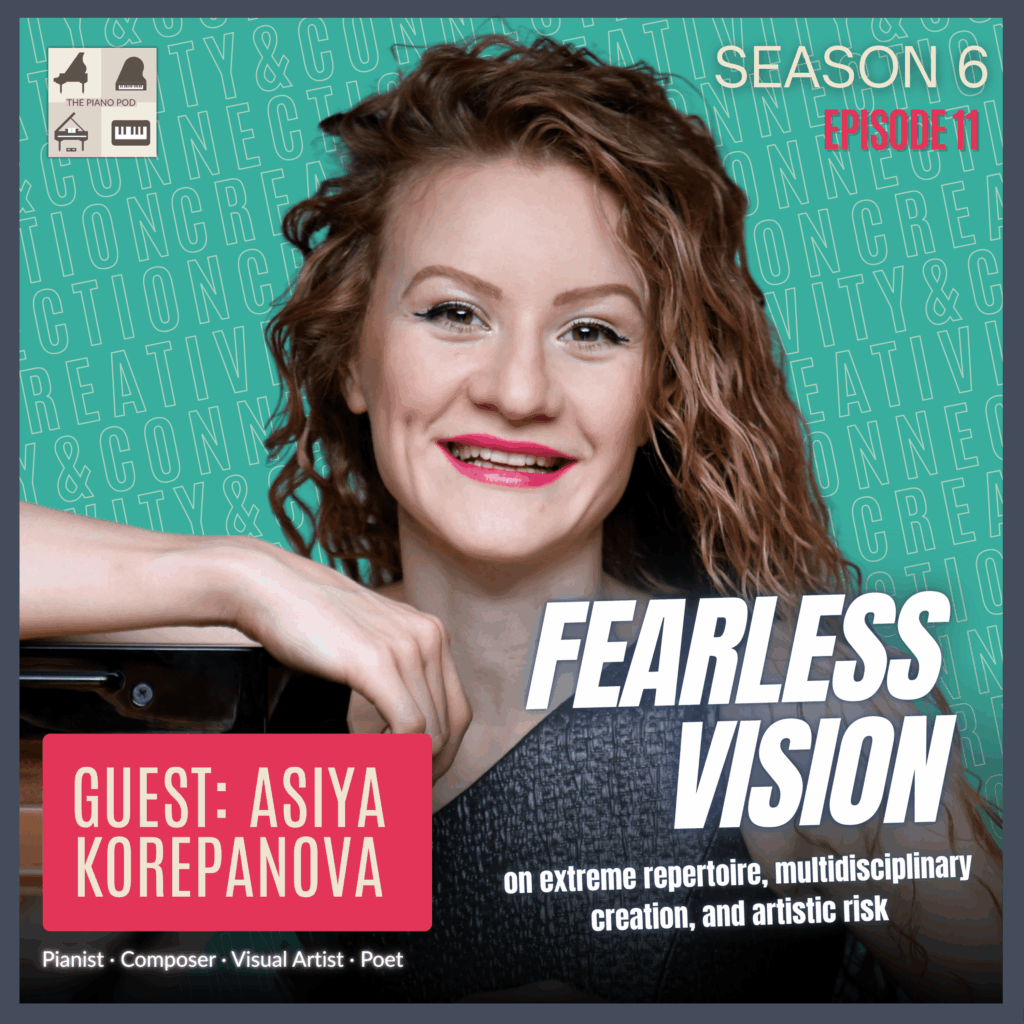
In this episode of The Piano Pod, host Yukimi Song sits down with pianist, composer, visual artist, and poet Asiya Korepanova for a wide-ranging conversation on extreme repertoire, transcription as a creative act, long-form artistic commitment, and what it means to think at scale as a musician today.
Born into a deeply musical family in Izhevsk, Russia, and now based in the United States, Asiya’s career is defined by projects many would consider “impossible”: performing the complete solo piano works of Rachmaninoff during the composer’s 150th-anniversary year, Liszt’s 24 Études, and Bach’s complete Well-Tempered Clavier. In this conversation, Asiya reflects on what draws her to repertoire that unfolds over years rather than hours, and how long-form thinking shapes her artistic identity.
A central focus of the episode is Asiya’s work as a transcriber. She speaks candidly about transcription as a form of composition—an act she once described as “taming a wild animal”—and how her deep understanding of orchestral, vocal, and chamber music informs the way she reimagines works for solo piano. We hear excerpts from her transcriptions of Mussorgsky’s Songs and Dances of Death and Bach’s Christmas Oratorio, alongside reflections on craft, risk, and responsibility.
The conversation also explores Asiya’s work beyond performance: her compositions, her multidisciplinary projects that integrate visual art and poetry, her commitment to education and access through her nonprofit Music for Minds, and her curatorial leadership at Festival Baltimore and Festival Flatiron NYC.
This episode offers a rare, unfiltered look into the inner life of an artist whose work is driven not by spectacle, but by depth, rigor, and fearless vision.
🔗 LINKS & RESOURCES
- Asiya Korepanova — Official Website
- Asiya’s Merch on Etsy
- Sounds of Inspiration — Piano Works from Season 6 (Music mentioned in this episode)
- Read the accompanying blog on Substack
🎧 THE PIANO POD
- 💖 Become a VIP Member / Unlock exclusive content
- 📫 Join our newsletter
- 🌐 Website: https://thepianopod.com
- Follow Us on Social Media: https://linktr.ee/thepianopod

